Amazon FBA vs FBM in 2026: Which Model Wins for Sellers? | SKZGROUP
published August 02, 2026Author: Fatima Fairuj Ruhi
Amazon FBA vs FBM in 2026: Which Model Wins for Sellers?
Amazon FBA vs FBM in 2026 compared on real fulfillment fees, storage costs, Buy Box odds, and profit margins so you can pick the right model per product.
Amazon changed the fulfillment math in 2026.
A new 3.5% fuel surcharge, steeper inbound defect penalties, and an aged-inventory threshold that now kicks in at 181 days instead of 271 have all pushed FBA costs higher.
So the old default, "just use FBA", no longer holds up for every product.
The real answer depends on weight, sell-through speed, and margin, checked SKU by SKU.
FBA and FBM in One Paragraph
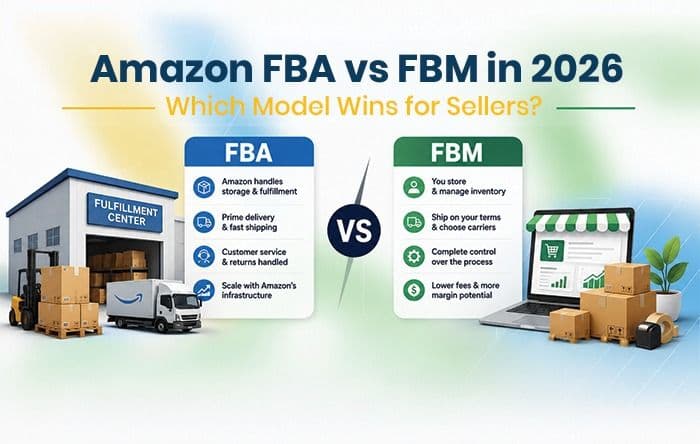
FBA (Fulfillment by Amazon) means you ship inventory into Amazon's warehouses and Amazon handles storage, picking, packing, shipping, and returns.
You get the Prime badge automatically, and it usually improves your odds in the Buy Box. FBM (Fulfillment by Merchant) means you or a third-party logistics (3PL) store and ship the products yourselves.
You keep more control over packaging and cost, but you don't get Prime unless you separately qualify for Seller Fulfilled Prime (SFP).
What Changed for FBA Sellers in 2026
A few fee updates are driving the FBA-vs-FBM conversation this year:1. Price-tiered fulfillment feesThe same product now costs a different amount to fulfill depending on whether it sells under $10, $10–$50, or over $50, creating a pricing puzzle for sellers who list across multiple prices.2. 3.5% fuel and logistics surchargeEffective mid-April 2026, applied on top of fulfillment fees for US and Canadian FBA orders.3.Inbound defect feesJumped sharply from $0.02–$0.07 per unit up to as high as $5.72 for standard items and $8.25 for bulky.4.A lower aged-inventory threshold
Impact & Future Plans
With this launch, SKZ Group aims at:
Reaching out to global regions with digital retail expertise
Bringing the latest products at customers’ forefront
Enhancing customer experience with automation
Fostering a digital e-commerce ecosystem with higher employment rates
SKZ Group believes that this new brand will prove to be a key player in future expansion.
SKZ Group serves with diverse knowledge within a broad eco-system, businesses, and individuals worldwide, both in technologies and international trade.
The surcharge window dropped from 271 days to 181 days, so slow-moving stock gets penalized sooner.
5.A low-inventory fee
Charging sellers roughly $0.89–$1.11 per unit sold once stock falls below a 28–35 day supply threshold — a fee that doesn't apply to FBM listings at all.
Taken together, one industry estimate cited by SellerSprite put total Amazon-related costs (fulfillment, ads, and fees combined) at 45–55% of revenue for many brands this year.
FBA vs FBM: The Real Cost Comparison
The comparison isn't just "fulfillment fee vs. shipping cost." A full FBA calculation includes referral fee, base fulfillment fee, the 3.5% surcharge, storage, inbound placement fees, and any aging or low-inventory penalties.
A full FBM calculation includes referral fee, outbound shipping, pick-and-pack labor, packaging, and your own (usually flat) storage cost.
For a standard $30 product under 1 lb with healthy turnover, FBA often still wins on net margin.
The Prime conversion lift trims the ad spend needed per sale enough to offset the extra fees. That flips for heavier or slower items: a roughly 35 lb, $90 product can run about $50 in FBA fees versus $34 for self-fulfillment.
As a rule of thumb, if a product weighs 3+ lb and runs under 20% margin, model the FBM numbers before defaulting to FBA.
When FBA Wins
FBA still makes the most sense for:1.Lightweight, fast-moving products (under 1–2 lb) in competitive categories, where Prime listings convert noticeably better than non-Prime ones2.High-velocity SKUs where fast turnover keeps storage costs low relative to sales3.Products where the Buy Box is critical — an FBA offer priced within 1–2% of an FBM competitor typically wins it4.New private-label launches that need ranking velocity during the first weeks5.Multi-marketplace or international expansion, where Amazon's global fulfillment network simplifies cross-border selling
When FBM Beats FBA
FBM (often through a 3PL) tends to come out ahead for:
→ Heavy or bulky items.
Anything over roughly 3 lb starts accumulating steep FBA surcharges, and large bulky items can face placement fees up to $6.50 per unit on every inbound shipment.
→ Slow-moving or seasonal inventory.
If a product might sit for more than 180 days, FBA's aging surcharges, which jump from $1.50 to $5.45 per cubic foot the moment you cross 270 days, will erode margin fast. A 3PL's flat storage rate avoids that cliff entirely.
→ Brands that care about the unboxing experience.
FBA ships in generic Amazon packaging with no room for inserts or branded boxes. FBM is the only route to a custom customer experience.
→ Products with unpredictable demand
FBM sidesteps the low-inventory fee entirely, which matters for sellers with inconsistent supply chains.
Seller Fulfilled Prime: The Middle Option
SFP lets qualifying FBM sellers keep the Prime badge without routing inventory through Amazon's warehouses.
It sounds ideal, but the bar is high. Sellers generally need on-time delivery around 97–99%, a cancellation rate under 0.5%, and the ability to hit one- or two-day delivery on most orders nationwide.
That level of performance usually requires multiple warehouse locations or paying for air shipping, so SFP tends to pay off only for sellers who already run a well-distributed fulfillment operation.
For most smaller sellers, it ends up costing more than plain FBA.
The Hybrid Approach Most Advanced Sellers Use
Sellers with larger catalogs increasingly avoid an all-or-nothing choice:1. FBA for top-selling, lightweight SKUs — where the Prime badge and Buy Box advantage matter most2. FBM for long-tail variants — colors, sizes, or accessories that move slowly and would rack up aging fees in FBA3. A standing FBM listing on every FBA product — so if FBA stock runs out, the listing stays live and holds search ran4. FBM for new launches — to test demand before committing to multi-location inbound shipping
Roughly a quarter to a third of high-volume sellers run some version of this hybrid model, reviewing SKU-level assignments quarterly as fees and sell-through shift.
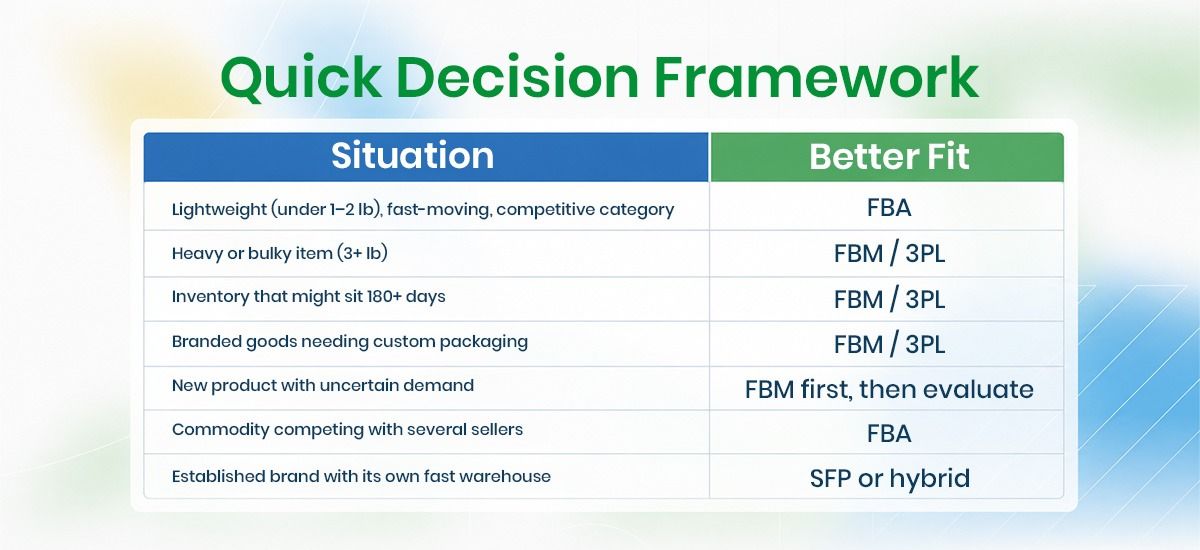
Quick Decision Framework
Bottom Line
There's no single winner between FBA and FBM in 2026.
The fee stack has simply made the decision more product-specific than it used to be.
Run the full math (referral fee, fulfillment fee, surcharge, storage, and any inbound or aging penalties) per SKU rather than per catalog, and revisit it every quarter as your inventory mix and Amazon's fee card both keep shifting.
Frequently Asked Questions
1. What's the main difference between Amazon FBA and FBM?
FBA means Amazon stores, picks, packs, and ships your orders, and handles returns; you automatically get the Prime badge. FBM means you or a 3PL handle storage and shipping yourselves, which gives you more cost and packaging control but no automatic Prime eligibility.
2. Is FBA still worth it in 2026 after the fee increases?
For lightweight, fast-moving products in competitive categories, generally yes. The Prime conversion lift still tends to outweigh the added fees. For heavy items, slow movers, or thin-margin products, the 2026 fee stack can make FBM more profitable.
3. What is Amazon's new 3.5% surcharge?
It's a fuel and logistics surcharge that took effect in April 2026 and is applied on top of FBA fulfillment fees for US and Canadian orders, including Multi-Channel Fulfillment.
4. When do Amazon's aged inventory fees start in 2026?
The aged-inventory surcharge now starts at 181 days in storage, down from 271 days previously, and the fees escalate sharply the longer a product sits.
5. Do FBM listings avoid the low-inventory fee?
Yes. The low-inventory-level fee, charged when FBA stock drops below a 28–35 day supply threshold, applies only to FBA listings, not to FBM.
6. Can I run FBA and FBM on the same listing?
Yes. Many sellers keep both offers active on one ASIN. FBA for speed, with an FBM backup that takes over if FBA stock runs out.
7. What is Seller Fulfilled Prime (SFP)?
SFP lets FBM sellers display the Prime badge by meeting strict delivery standards themselves, without storing inventory in Amazon's warehouses. It suits sellers with fast, reliable fulfillment already in place.
8. Does FBA or FBM win the Buy Box more often?
FBA generally has an edge because Amazon prioritizes Prime-eligible, fast-shipping offers. FBM sellers can still win the Buy Box with strong performance metrics, especially for products with few competing offers.
9. Is FBM cheaper than FBA for heavy products?
Often, yes. Items over roughly 3 lb can trigger high FBA fulfillment and placement fees, sometimes making self-fulfillment or a 3PL noticeably cheaper per unit.
10. Should I use a hybrid FBA/FBM strategy?
Many established sellers do, using FBA for fast-moving, lightweight bestsellers and FBM for bulky, seasonal, or slow-moving SKUs, reviewing the split every quarter as fees and sales patterns change.