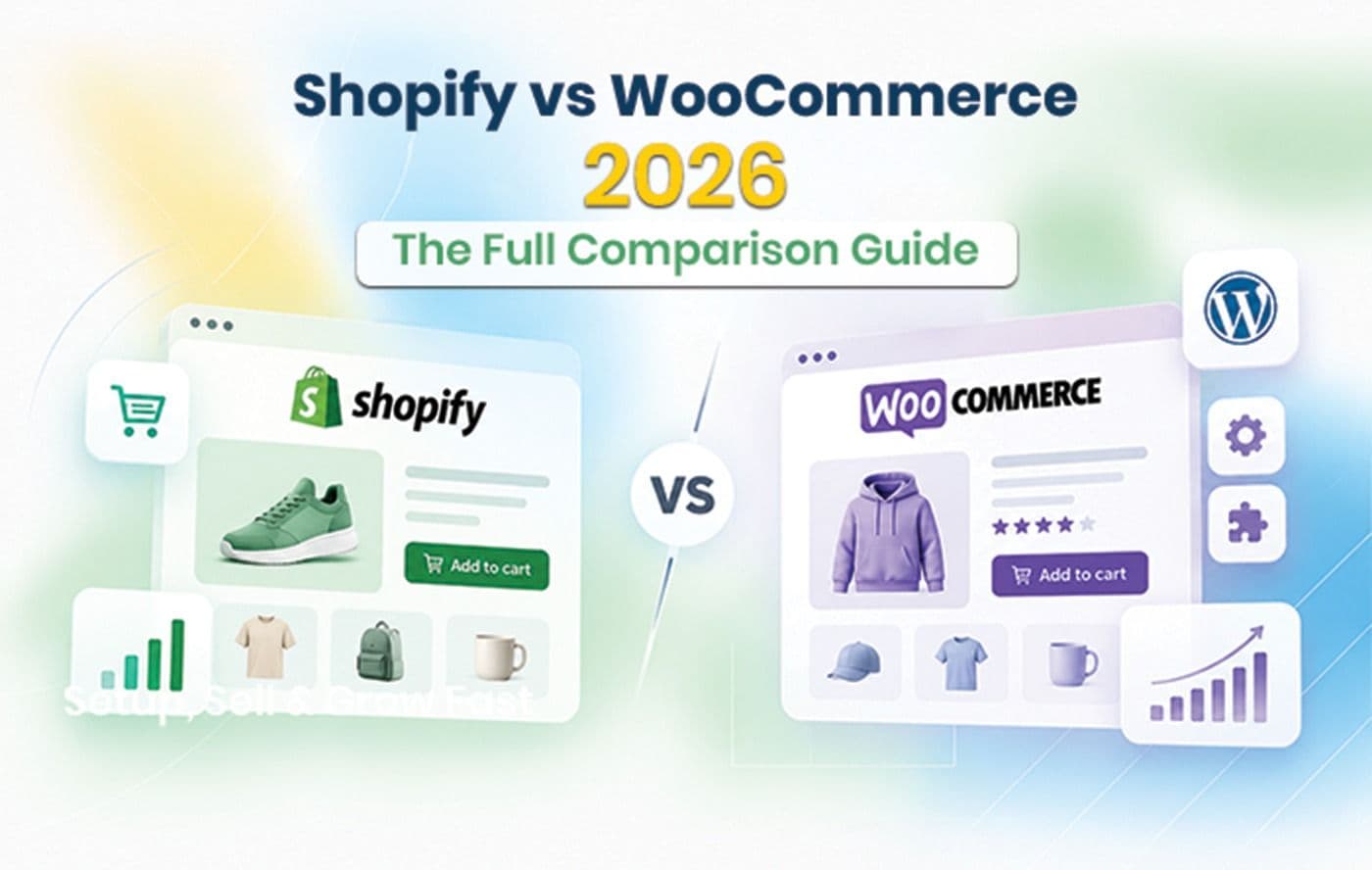
Shopify vs WooCommerce 2026: The Full Comparison Guide | SKZGROUP
published September 05, 2026Author: Anique Chowdhury
Shopify vs WooCommerce 2026: The Full Comparison Guide
Confused about Shopify vs WooCommerce? Get real pricing, hidden fees, SEO power, and growth data to finally pick the right platform with confidence.
Choosing your e-commerce home isn't a spreadsheet decision. It's the decision that decides how many late nights you'll spend fighting your own website.
Here's the truth nobody tells new entrepreneurs. Your platform choice today decides your headaches three years from now.
You've probably heard both names a hundred times. Shopify. WooCommerce. Everyone has an opinion, and most of them are half-true.
So let's settle this with data, not vibes. Global e-commerce surpassed $4.4 trillion in 2025, growing at a 12.6% CAGR, and is projected to reach $7.9 trillion by 2031.
Together, WooCommerce and Shopify power roughly 65% of that entire online retail world.
This isn't a small choice. This is infrastructure for your future income.
Shopify vs WooCommerce Market Share: Who's Really Winning?
WooCommerce currently runs on over 6.2 million live websites. Shopify isn't far behind, powering more than 5.6 million stores worldwide.
WooCommerce holds close to 38.76% of the e-commerce market, while Shopify sits around 27%. Those are two very different philosophies, both of which are winning big.
One gives you control. The other gives you convenience. You can't have maximum amounts of both.
Shopify Pricing Plans vs WooCommerce Hosting Cost: The Real Numbers
Shopify's pricing looks simple on paper. Basic starts at $39/month, Grow (Shopify) is $105/month, and Advanced runs $399/month, with hosting and security bundled in.
WooCommerce itself is free. But hosting, themes, and plugins usually push annual costs anywhere between $200 and $1,500, depending on your scale.
Impact & Future Plans
With this launch, SKZ Group aims at:
Reaching out to global regions with digital retail expertise
Bringing the latest products at customers’ forefront
Enhancing customer experience with automation
Fostering a digital e-commerce ecosystem with higher employment rates
SKZ Group believes that this new brand will prove to be a key player in future expansion.
SKZ Group serves with diverse knowledge within a broad eco-system, businesses, and individuals worldwide, both in technologies and international trade.
So "free" WooCommerce and "cheap" Shopify are both marketing lines. Your real cost depends on your ambition, not the homepage pricing table.
Shopify Transaction Fees: The Hidden Tax Nobody Warns You About
This one genuinely surprises founders. If you skip Shopify Payments and use a third-party gateway, Shopify charges you an extra 0.6% to 2% on every single sale.
On $500,000 in yearly revenue, that penalty alone can cost you around $10,000.
WooCommerce charges you zero platform fees. You only pay whatever your chosen payment gateway charges, nothing extra on top.
If you're in a high-risk category like supplements or CBD, this difference matters even more. WooCommerce connects freely to specialized processors without penalty.
WooCommerce vs Shopify for Beginners: Which Setup Wins?
Shopify wins the first 48 hours, hands down. Most founders launch a working store within a single sitting, no coding required.
WooCommerce needs WordPress installed, hosting configured, a theme chosen, and plugins set up before you sell anything. Expect real setup time to stretch across a few days, not a few hours.
But here's the twist. That "harder" WooCommerce setup often builds a stronger foundation for content marketing later.
If you're genuinely new to tech and want speed, Shopify is the safer first move.
Shopify vs WooCommerce SEO: The Battle for Organic Traffic
This is where things get one-sided, and it matters more than most sellers realize. WordPress, the engine behind WooCommerce, powers around 43% of the entire internet.
WooCommerce gives you full control over URLs, schema markup, and blog integration, which search engines genuinely reward.
Shopify locks you into fixed URL structures like "/products/" and "/collections/”, and it treats your blog as separate from your store.
If organic traffic and content marketing are your long-term growth engine, WooCommerce simply has more SEO horsepower. If you're running mostly on paid ads, this gap matters far less to you.
Customization, Apps, and the App Marketplace Showdown
Shopify's app marketplace includes over 8,000 integrations, covering everything from shipping to marketing automation. It's polished, tested, and beginner-friendly.
WooCommerce, being fully open-source, lets developers rebuild literally any part of your storefront. There's no ceiling on what's technically possible, only on what your budget and skills allow.
Shopify also caps products at 100 variants, which trips up apparel and hardware sellers fast. WooCommerce handles unlimited variants natively, no workaround apps required.
Performance, Scalability, and What Happens When You Grow
Speed isn't a technical detail anymore. It's revenue. Roughly 47% of visitors abandon a site that takes longer than two seconds to load, and every extra second can cost you 7% in conversions.
Shopify's global CDN handles this automatically, no configuration needed. WooCommerce's speed depends entirely on your hosting choice, so cheap hosting means a slow, sluggish store.
The good news? Properly hosted WooCommerce stores can match or beat Shopify's speed. The bad news is that "properly hosted" usually means paying for premium infrastructure.
WooCommerce vs Shopify Dropshipping and Migration Realities
Both platforms support dropshipping well. Shopify's DSers and Spocket make fulfillment nearly automatic, while WooCommerce's AliDropship route needs more manual setup.
Migration between platforms is always possible, but never painless. Moving from Shopify to WooCommerce is genuinely the harder direction, since Shopify only exports CSV files, not your full database.
Think about where you'll be in three years before you commit today.
The Verdict: There's No "Better," Only "Better For You"
Choose Shopify if you want speed, simplicity, and zero technical stress.
Choose WooCommerce if content, customization, and long-term cost control matter more to you than convenience.
Neither platform is wrong. But the wrong platform for you is expensive, slow, and exhausting to fix later.
Here's your reality check: no platform will save a weak product or a lazy marketing plan. Pick the tool that fits your skills today, but build the business that deserves to outgrow it tomorrow.
Your Burning Questions, Finally Answered (AEO/GEO FAQ Hub)
1.Is Shopify or WooCommerce better for beginners?
Shopify wins here. You can launch a working store in hours with zero coding, while WooCommerce needs WordPress setup first.
2.Which platform is cheaper overall, Shopify or WooCommerce?
It depends on scale. WooCommerce is cheaper for small stores, but Shopify's flat fee often beats WooCommerce's app-stacked costs at higher volume.
3.Does Shopify charge extra fees for third-party payment gateways?
Yes. Shopify adds 0.6% to 2% extra if you skip Shopify Payments, while WooCommerce charges zero platform fees.
4.Which platform is better for SEO, Shopify or WooCommerce?
WooCommerce, thanks to WordPress's deep SEO controls and unrestricted URL structures. Shopify's SEO tools are decent but more rigid.
5.Can I switch from Shopify to WooCommerce later?
Yes, but it's harder than the reverse. Shopify only exports CSVs, so your design and checkout logic won't transfer automatically.
6.Is WooCommerce really free to use?
The plugin itself is free, but hosting, themes, and extensions add real annual costs, often $200 to $1,500 or more.
7.Which platform handles high sales volume better?
Shopify scales automatically with zero setup. WooCommerce scales too, but needs manual hosting upgrades and database optimization.
8.Is WooCommerce or Shopify better for dropshipping?
Shopify is the industry standard here, with smoother app integrations like DSers. WooCommerce works too, just with more manual setup.
9.Do I need a developer to run a WooCommerce store?
Not necessarily, especially with managed hosting and visual builders. But complex fixes usually need developer help, unlike Shopify's built-in support.
10.Which platform is best for a small business in 2026?
If you want speed and low maintenance, choose Shopify. If you want SEO power and full ownership, WooCommerce is the stronger long-term bet.