Amazon Restricted Products: The List That Can Break Your Business Before It Starts | SKZGROUP
published August 17, 2026Author: Fatima Fairuj Ruhi
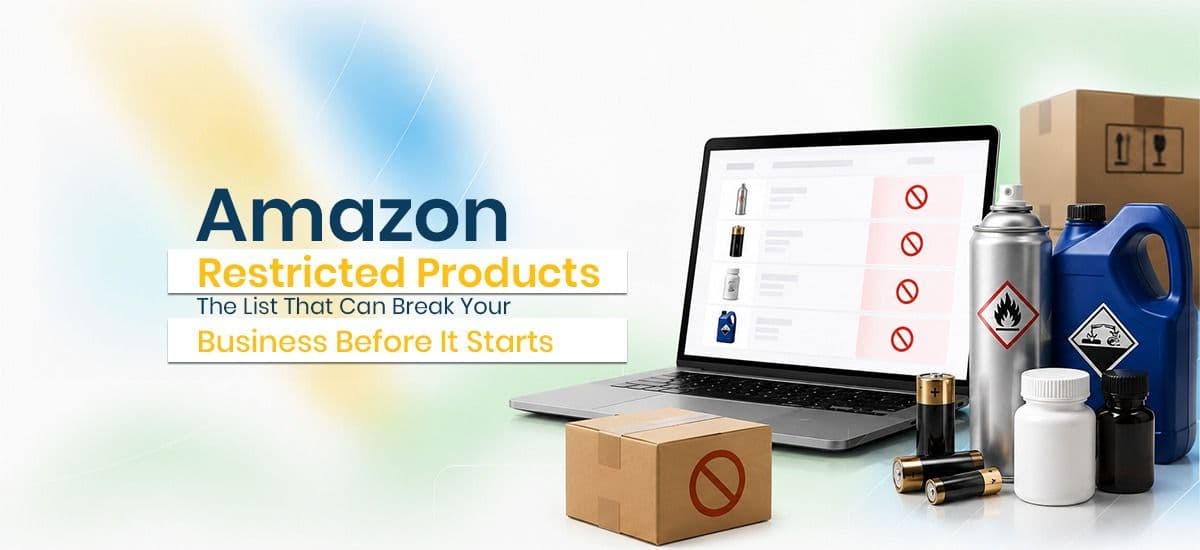
Amazon Restricted Products: The List That Can Break Your Business Before It Starts
Amazon restricted products can freeze your account overnight. Learn what to avoid, how gating works, and how to sell safely as a beginner.
Let's clear up the confusion first.
"Restricted" and "prohibited" are not the same thing.
Restricted products need Amazon's approval before you can list them, while prohibited products can never be sold on the platform. Period.
This one distinction changes your entire sourcing strategy.
A restricted product isn't a dead end. It's a locked door. You just need the right key to open it. Documents, invoices, certifications.
A prohibited product is a wall. No key exists.
Why Amazon Locks Down So Many Categories
Amazon isn't restricting products to annoy sellers.
These rules exist to protect legal compliance, product quality, and brand trust across the marketplace.
Think about it from a buyer's side. Would you trust a marketplace where anyone could sell unregulated supplements or fake electronics?
That trust is Amazon's entire business model. Every gate you hit exists because someone, somewhere, got hurt or scammed before you got there.
The Real List: Amazon Gated Categories New Sellers Keep Bumping Into
Here's where most beginners get stuck.
Amazon is gating and restricting more brands and categories every year, and selling gated or restricted products can get your seller account suspended.
Categories that commonly require approval include:
Supplements and health products
Impact & Future Plans
With this launch, SKZ Group aims at:
Reaching out to global regions with digital retail expertise
Bringing the latest products at customers’ forefront
Enhancing customer experience with automation
Fostering a digital e-commerce ecosystem with higher employment rates
SKZ Group believes that this new brand will prove to be a key player in future expansion.
SKZ Group serves with diverse knowledge within a broad eco-system, businesses, and individuals worldwide, both in technologies and international trade.
Beauty and skincare items
Jewelry and fine watches
Automotive parts
Certified refurbished electronics
Collectible coins and entertainment memorabilia
Topical medical devices
The good news? Popular categories like toys, groceries, home and kitchen, beauty, and books aren't gated for most new sellers. Though individual products or brands inside them still might be.
Don't panic. This isn't a small playing field. It's still millions of products wide.
Products Amazon Bans Completely (No Approval Fixes This)
Some things you should never touch, no matter how tempting the margin looks.
Alcohol is restricted because of complex regulatory requirements around age verification and shipping laws across states and countries.
Add to that list: Illegal drugs, weapons designed to cause harm, hazardous materials, and anything violating safety codes.
If a product needs a government license just to touch, assume Amazon wants nothing to do with it either.
The Hidden Trap: Brand Gating (Not Just Category Gating)
Here's what catches new sellers off guard the most.
Even in an "open" category, individual brands can be gated separately.
To sell a gated brand, sellers typically need valid invoices, usually from the last 180 days, showing at least 10 units purchased from an authorized manufacturer or distributor.
No invoice, no listing. It's that simple.
Worse, some brands now hand Amazon a private "whitelist" of approved sellers. If you're not on it, Amazon may flag you for an intellectual property violation, even with 100% genuine stock.
Always ask: am I buying direct from the brand or an authorized source? If you can't answer that clearly, don't list yet.
What Happens If You Skip the Rules Anyway
This is the part sellers underestimate.
Selling in gated categories like supplements, medical devices, or pesticides without proper approval can lead to immediate listing suppression or full account suspension.
And it's not a slow fade. It's often instant.
With over 9.7 million sellers worldwide and increasingly aggressive AI-driven enforcement, suspensions are only getting more frequent, not less.
Even genuine sellers get hit. Suspected IP violation suspensions can be triggered by automated detection alone, without any formal complaint from a rights holder.
Copied product text or a borrowed supplier photo can be enough.
That's your entire inventory, cash flow, and reputation, frozen overnight.
Your Step-by-Step A-to-Z Safety Checklist
Here's the exact routine seasoned sellers follow before listing anything new.
Step 1 —Check restriction status first, always. Never source a product before verifying it in Seller Central.
Step 2 — Confirm the category. Search whether your product category needs approval.
Step 3 — Confirm the brand separately. A clean category doesn't mean a clean brand.
Step 4 — Get real invoices. Buy from authorized distributors only. Keep every document.
Step 5 — Document everything. Screenshot your restriction checks, note the date, and record the method used; this becomes your proof if a product's status suddenly shifts.
Step 6 — Recheck regularly. A product that's clear today could become restricted next year, and Amazon rarely sends a big red flag when it happens.
Step 7 — Build a "suspension file" now, not later. Successful long-term sellers keep a ready folder of invoices, supplier contacts, and compliance notes — before they ever need it.
Infographics:
Smart Categories for Beginners (Low-Risk, High-Reward)
If you're just starting, don't fight the gates. Sidestep them.
Focus on home goods, kitchen tools, books, and general toys where restrictions are lighter for newcomers.
Build sales history and account health first. Once you've proven reliability, ungating harder categories becomes far easier; Amazon trusts sellers with a track record.
Slow and steady genuinely wins this race.
The Reality Check: This Isn't Optional Homework
Here's the part nobody wants to hear.
Compliance isn't a "nice to have" for Amazon sellers. It's the entire foundation your business stands on.
Amazon maintains detailed and frequently updated lists of restricted and prohibited products, and items once allowed can become restricted with little notice.
That means this guide isn't a one-time read. It's a habit you check before every single new SKU.
Where This Leaves You
You now know the difference between restricted and prohibited.
You know brand gating catches more sellers than category gating does.
You know documentation is your best defense, not an afterthought.
Selling on Amazon is genuinely one of the best businesses you can start today. Millions of sellers prove it works.
But the sellers who last aren't the fastest movers. They're the most careful ones.
Check before you source. Document before you list. Build your suspension file before you ever need it.
Do that, and restricted products stop being a threat; they just become one more checklist item you've already handled.
For Bangladeshi entrepreneurs, setting up the right banking structure is an important step after forming a US company. If you are unsure about the process, this guide explains how to open a US bank account for your LLC from Bangladesh and manage your business finances more efficiently.
Questions New Sellers Actually Ask (Answered Fast) 1.What's the difference between restricted and prohibited products on Amazon?“Restricted” means you need approval first. “Prohibited” means never, under any circumstance. Know which one you're dealing with before you buy inventory.2.Can I sell restricted products on Amazon at all? Yes, often. You just need approval — usually invoices, certifications, or brand permission — before your listing goes live.3.How do I check if a product is restricted before I buy it? Search the product or category directly in Seller Central's restrictions tool before sourcing anything.
4.What is Amazon brand gating? It's when a specific brand — not the whole category — requires proof of authorized sourcing before you can list its products.5.How many invoiced units do I need to get ungated? Typically at least 10 units from an authorized manufacturer or distributor, dated within the last 180 days.6.Can my account get suspended even if my products are genuine? Yes. Unauthorized sourcing, even of authentic goods, can trigger an IP complaint and suspension.7.Which product categories are safest for beginners? Home and kitchen, books, toys, and groceries are generally lighter on restrictions for new sellers.8.Does a restriction status ever change after I've started selling? Constantly. A product clear today can become gated next year with little warning from Amazon.9.What should I do if Amazon flags my listing as restricted? Remove the item immediately and build a clear plan of action before appealing — don't wait it out.10.How can I protect my account before something goes wrong? Keep a standing "suspension file". Invoices, supplier details, compliance notes, ready before you ever need it.