Start a Shopify Store from Bangladesh Step-by-Step 2026 | SKZGROUP
published August 30, 2026Author: Anique Chowdhury
Start a Shopify Store from Bangladesh Step-by-Step 2026
Want to start a Shopify store from Bangladesh in 2026? Get real costs, payment fixes, shipping tips, and a step-by-step launch plan inside.
Bangladesh's e-commerce market crossed the $4 billion mark in early 2026, growing at roughly 22% a year.
More than 60 million Bangladeshis now shop online regularly, and over 65% of the country is under 35.
That's not a market. That's a wave. The question isn't "should I sell online." It's "why haven't I built a store that can sell to the whole world, not just Dhaka?"
That's where Shopify comes in. And that's exactly what this guide unpacks, from account setup to the payment mess nobody warns you about.
Why Shopify, Not Daraz or a Facebook Page?
Facebook pages get you started. They don't get you scale.
A Facebook shop can't run automated email flows, real analytics, or a checkout that converts on autopilot. Shopify's built-in checkout is proven to convert better than the average DIY setup, and it lets you sell locally while quietly opening the door to international buyers too.
You also own the platform. Your Facebook page can get restricted overnight, your Shopify store can't.
What It Actually Costs to Start (No Sugarcoating)
Here's the number everyone searches for. Shopify's core Basic plan runs $39 a month if you pay monthly, or an effective $29 a month if you pay annually.
There's also a cheaper $5/month Starter plan, but it skips a full storefront — skip it if you want a real website. On top of the plan, budget for a domain, a theme, and a few apps.
Realistically, expect 50–150/month all-in for a lean, functioning store. Compare that to a physical shop's rent in Gulshan or Banani, and it's not even close.
The Payment Puzzle: Solve This First, Not Last
Impact & Future Plans
With this launch, SKZ Group aims at:
Reaching out to global regions with digital retail expertise
Bringing the latest products at customers’ forefront
Enhancing customer experience with automation
Fostering a digital e-commerce ecosystem with higher employment rates
SKZ Group believes that this new brand will prove to be a key player in future expansion.
SKZ Group serves with diverse knowledge within a broad eco-system, businesses, and individuals worldwide, both in technologies and international trade.
This is where most Bangladeshi sellers get stuck. Shopify Payments isn't available here yet, so you can't just flip a switch like a US seller would.
The fix almost every serious BD Shopify seller uses is SSLCommerz. SSLCommerz is Bangladesh's largest payment gateway and connects bKash, Nagad, Rocket, and every major local bank through one integration.
Approval isn't instant. Approval for a Bangladeshi business typically takes 3–5 business days, so apply for it in week one, not launch week.
Don't skip Cash on Delivery either. Bangladeshi buyers still lean on it heavily, and it builds trust while your digital payment reputation grows.
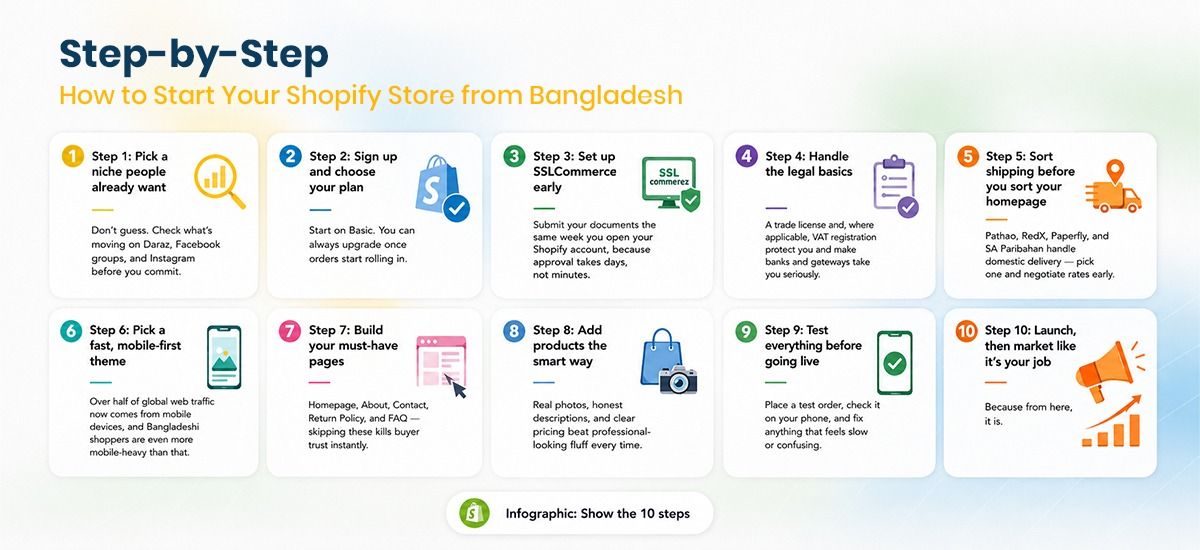
Step-by-Step: How to Start Your Shopify Store from Bangladesh
Step 1: Pick a niche people already want
Don't guess. Check what's moving on Daraz, Facebook groups, and Instagram before you commit.
Step 2: Sign up and choose your plan
Start on Basic. You can always upgrade once orders start rolling in.
Step 3: Set up SSLCommerz early
Submit your documents the same week you open your Shopify account, because approval takes days, not minutes.
Step 4: Handle the legal basics
A trade license and, where applicable, VAT registration protect you and make banks and gateways take you seriously.
Step 5: Sort shipping before you sort your homepage
Pathao, RedX, Paperfly, and SA Paribahan handle domestic delivery — pick one and negotiate rates early.
Step 6: Pick a fast, mobile-first theme
Over half of global web traffic now comes from mobile devices, and Bangladeshi shoppers are even more mobile-heavy than that.
Step 7: Build your must-have pages
Homepage, About, Contact, Return Policy, and FAQ — skipping these kills buyer trust instantly.
Step 8: Add products the smart way
Real photos, honest descriptions, and clear pricing beat "professional-looking" fluff every time.
Step 9: Test everything before going live
Place a test order, check it on your phone, and fix anything that feels slow or confusing.
Step 10: Launch, then market like it's your job
Because from here, it is.
step by step how to start shopify store
The Mistakes That Quietly Kill New Stores
Building without checking demand first is the biggest one. Don't spend three months designing a store for a product nobody's searching for.
Vague shipping costs are the second killer. Hidden fees at checkout are one of the top reasons carts get abandoned everywhere in the world, and Bangladeshi buyers are no more forgiving.
Ignoring mobile design is the third. If your store feels clunky on a phone, most visitors simply leave.
And the fourth is expecting instant results. Most stores worldwide take three to six months to become genuinely profitable.
Patience isn't optional here; it's strategy.
Marketing Your Store Once It's Live
Shopify gets you a store. It doesn't get you customers.
Facebook and Instagram remain the strongest starting channels for Bangladeshi audiences, especially with reels and short video content. Pair that with basic SEO on your product pages, and organic traffic starts compounding without ad spend.
Email flows matter more than people think too — a simple welcome email and an abandoned cart reminder can recover sales you'd otherwise lose forever.
Your Reality Check (Said With Love)
This is genuinely one of the best times in history to build an online brand from Bangladesh. The country's e-commerce earnings are projected to grow at roughly 22% a year through 2028, and the tools to compete globally now cost less than a phone bill.
But Shopify won't make you money by itself. It's a shop, not a genie.
Every successful store I've watched over 15 years had the same pattern: boring consistency, not viral luck.
Build the store, fix the payment gateway, ship on time, and show up every week; that's the whole game.
Your Questions, Answered Straight (No Fluff FAQ Zone)
1. Can I really start a Shopify store from Bangladesh?
Yes, absolutely. You just need to solve payments and shipping locally, everything else works exactly like anywhere else.
2. Does Shopify accept bKash or Nagad directly?
Not directly, but SSLCommerz bridges that gap and brings bKash, Nagad, and Rocket into your Shopify checkout.
3. How much money do I need to start?
Plan for roughly 50–150 a month covering your plan, theme, and a couple of apps — inventory costs come on top if you're not dropshipping.
4. Do I need a trade license before I launch?
It's not always required day one, but getting one early builds trust with banks, gateways, and customers alike.
5. Can I sell internationally from a Bangladesh-based store?
Yes, and it's actually one of Shopify's biggest advantages over local-only platforms.
6. Which courier service should I use for local delivery?
Pathao, RedX, and Paperfly are the most reliable names — many sellers use two together for backup.
7. How long until my store becomes profitable?
Most new stores worldwide take three to six months, so give yourself real runway before judging results.
8. Is dropshipping realistic from Bangladesh?
Yes, though local shipping speed and supplier reliability need extra attention compared to sellers shipping from China or the US.
9. What's the biggest mistake new Bangladeshi sellers make?
Building the "perfect" store before validating if anyone actually wants the product.
10. Do I need coding skills to build a Shopify store?
Not at all — Shopify's drag-and-drop builder and free themes are made for exactly this situation.